
The moment a patient walks into your dental practice, the first thing they see is a friendly smile. Front desk and receptionist positions may go by many names, but they always have an important role in the administrative and customer service aspects of a dental practice. There are some differences between dental front desk and receptionist positions, and their responsibilities, pay, and skillsets may differ. Learn the relevant job requirements, skills, and salary trends so you can hire and retain those friendly employees.
Defining Dental Front Desk and Receptionist Roles
In some practices, there’s no difference between a front desk employee and a receptionist. In others, it’s a totally different job. Even when their titles differ, both positions require a team player attitude, excellent communication skills, and customer service. They’ll need solid computer skills to handle your practice management software, too.
These responsibilities can help you understand the real work that goes into running the front desk at a dental practice. From there, you can write a legally compliant, well-rounded job description that attracts the right talent.
Responsibilities for Dental Front Desk Staff
Dental front desk professionals often act as administrative managers. They handle more in-depth tasks that require a thorough understanding of dental practices and procedures. Also known as Patient Care Coordinators, Office Coordinators, or Patient Experience Coordinators, we can break down these roles into a few categories:
Patient Records & Documentation
- Maintain complete and accurate patient records
- Manage digital forms, treatment documentation, and insurance data
- Ensure compliance with privacy standards
Insurance & Financial Coordination
- Verify benefits and obtain pre-authorizations
- Submit and track insurance claims
- Present treatment estimates and payment options
- Manage accounts receivable and collections
- Provide financial counseling and payment planning
Schedule & Treatment Coordination
- Optimize provider schedules and treatment sequencing
- Manage recall and continuing care systems
- Track unscheduled treatment and follow-up
- Support case acceptance initiatives
Patient Experience Management
- Serve as primary contact for patient concerns
- Coordinate follow-up communication and service recovery
- Support retention and long-term care planning
Clinical & Staff Coordination
- Liaise between providers, assistants, and administrative staff
- Support daily operational workflow
- Assist with team scheduling coordination
Technology & Systems
- Manage practice management software workflows
- Maintain digital communication tools and patient portals
Practice Performance Support
- Monitor schedule productivity and financial targets
- Support reporting on collections, treatment acceptance, and retention
Marketing & Growth Support (practice-dependent)
- Track referrals and patient engagement
- Support membership plans or promotions
- Assist with reputation management
Responsibilities for a Dental Receptionist
On the other hand, dental receptionists are often the first point of contact for patients. Their primary role revolves around providing exceptional patient service. These employees can also be called Patient Intake Coordinators, Patient Services Representatives, or Office Assistants. The term Secretary tends to be outdated for this particular role, so we don’t recommend using it when creating a modern job description.
Patient Greeting & Check-In/Out
- Welcome patients and visitors in a professional and friendly manner
- Verify patient information and update basic records
- Manage patient check-in and check-out processes
Appointment Scheduling
- Schedule and confirm patient appointments
- Manage cancellations and rescheduling
- Send reminders via phone, text, or email
Communication Management
- Answer phones and respond to general inquiries
- Route messages to appropriate staff
- Handle basic patient questions regarding appointments or office policies
Administrative Support
- Maintain front desk organization and paperwork
- Scan, file, and manage incoming documents
- Process simple payments and provide receipts
Office Support
- Maintain waiting area cleanliness and comfort
- Assist with general office tasks as needed
Job Descriptions for Dental Front Desk and Receptionist Roles
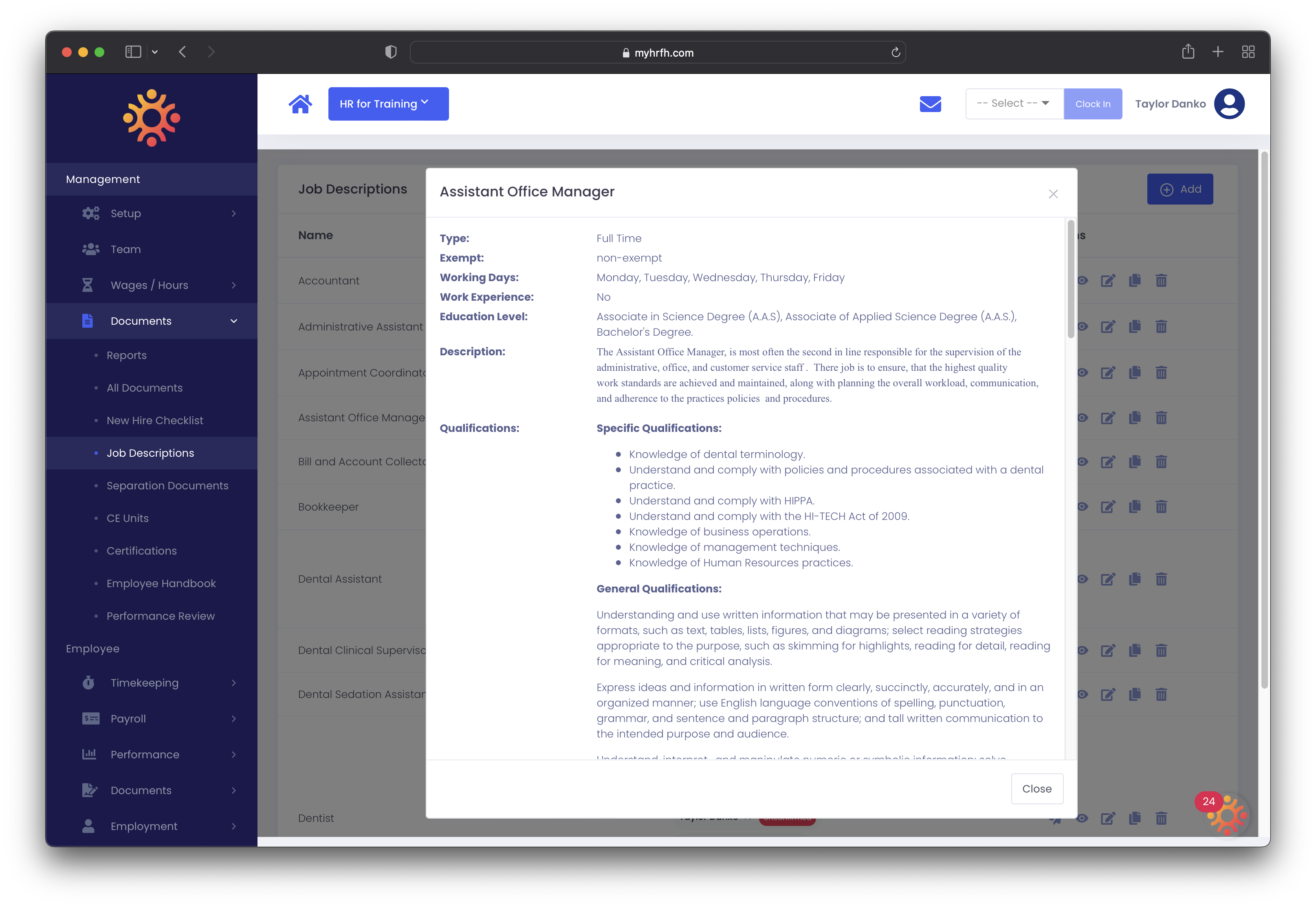
Ready to build out the job description? You can use one of HR for Health’s pre-built templates, or you can create your own based on the responsibilities above, and the expectations below.
Requirements, Skills, and Experience
Again, these jobs may go by many names, and depending on your practice’s needs, they may be rolled into one. These are the basic skills and experience levels required for any front desk or receptionist position at a dental practice:
Dental Front Desk
- High school diploma or equivalent is required.
- Familiarity with dental insurance or medical billing is an asset.
- Strong computer and data entry skills.
- Proficiency with dental practice management software.
- Excellent communication and organization skills.
Dental Receptionist
- High school diploma or equivalent is required.
- Prior experience in customer service or reception is preferred.
- Strong computer and data entry skills.
- Excellent verbal communication, multitasking, and problem-solving abilities.
- Ability to maintain confidentiality and professionalism.
Average Salary for Front Desk and Receptionist Roles
As of spring 2026, the average salary for dental front desk professionals in the United States is between $30,000 to $45,000. Of course, this depends greatly on location, skills, and type of work. And it doesn’t include bonuses, benefits like health insurance, sick pay, vacation, retirement, or stipends.
The actual salary band depends on factors like professional experience, the size of your dental practice, and your location (or locations). A highly experienced employee, whether they’re front desk or reception, can command a higher salary. Same for those who work in large or prestigious practices.
Here’s a quick breakdown of the salary trends we’ve seen lately. Remember, these salary bands do not factor in experience, additional education, other responsibilities, or precise location (which is the most important factor in determining salary).
| Dental Front Desk (Patient Care Coordinator) Salary | Dental Receptionist (Patient Services Representative) Salary | |
| New York | $50,000 – $70,000 per year ($24 – $34 per hour) | $44,000 – $51,000 per year ($21 – $25 per hour) |
| California | $46,000 – $52,000 per year ($22 – $25 per hour) | $42,000 – $48,000 per year ($20 – $23 per hour) |
| National Average | $38,000 – $45,000 per year ($18 – $22 per hour) | $30,000 – $40,000 per year ($15 – $19 per hour) |
Training and CE Units Management
As your employees’ skillset and expertise grow, dental practices can manage and track employee training programs and continuing education. HR for Health tracks certifications and licenses, so you won’t lose track of dates or CE units.
- Record individual training and CE courses
- Track course completion
- Get a heads up before CEUs expire
- Manage staff licensure
- Customize notifications and alerts
- Generate reports to find training gaps
2026 Trends in Front Desk and Receptionist Positions
- Blended job descriptions and duties. We are seeing front desk and receptionists take on a lot more in billing, insurance, and marketing recently. In our experience, practice owners find it much easier to have those tasks completed during downtime. If the practice is slow or closed to patients, that could be a great time to take care of admin or even social media.
- Increased demand and growth. We’ve also noticed a rising demand for dental services in general. Thanks to increased dental health awareness, dental practices require more staff to meet this demand. That leads to a surge in hiring for all dental industry positions, including front desk and receptionist roles.
- Emphasis on experience. Dentistry is in a shift towards a person-first experience, with practices focusing on providing personalized services and better patient care. That’s not new, but it does mean that enthusiastic front desk professionals and receptionists are more important than ever. Their people skills are just as valuable as their administrative tasks.
- Temporary and contract help. Staffing in a dental practice can be unpredictable due to personal leave, holiday rushes, sudden departures, or an unexpected influx of patients. When that happens, temporary staffing agencies prove to be incredibly beneficial.
- Creative benefits and work arrangements. Employees are now more interested in flexible work arrangements, comprehensive benefits, employee wellness, salary transparency, upskilling, and professional development. Fortunately, you can keep it all straight with HR for Health.
Hire and Onboard with Confidence — and HR for Health
Ready to bring on your next team member? HR for Health has templates that get your job descriptions for front desk staff off to a great start. Once you’ve found an awesome candidate, we can help you bring them onboard and set them up for success. Sync their schedule to your payroll and stay up to date on employment laws, and the only thing you’ll have to worry about is focusing on delivering excellent patient care. And isn’t that what it’s all about?
Schedule a demo today to learn more about optimizing your dental practice’s management with HR for Health.