
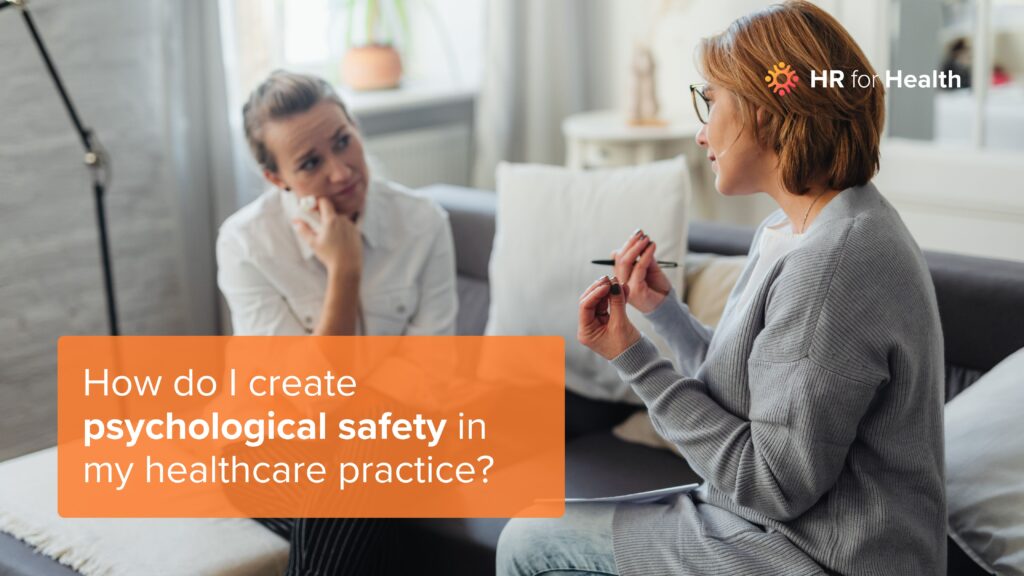
You might have come across the concept of psychological safety before: it’s the belief that the workplace should be a safe place to speak up about questions, ideas, mistakes, or concerns. In most workplaces, it improves interpersonal dynamics, efficiency, and helps employees work better together. Great for business, awesome for team building. But prioritizing psychological safety in healthcare does all that and it promotes patient safety. Speaking up and preventing mistakes could literally be life and death.
In an industry as high-stress as healthcare, your team has to feel empowered to press the pause button. They need to be able to raise their hands about problems, and they need to have their voices heard. Creating an environment of psychological safety isn’t always easy, but we’ll help you get started.
| Our HR Experts’ Advice – A good healthcare workplace culture benefits employees, patients, and your practice’s success. – It’s not about babying your team. When employees are able to speak up about concerns and ask for help, you build trust and get ahead of problems that could be serious. – HR for Health’s 3 tips for psychological safety can help you get started. |
What Does Psychological Safety Look Like in Healthcare?
Psychological safety means deliberately taking away the fear of interpersonal repercussions when addressing concerns. Essentially, it’s comfort with expressing discomfort. In a secure healthcare environment, that can look like:
- Freely speaking up about errors and asking for help
- Questioning decisions that impact work or patient care
- Giving and receiving constructive criticism and voicing disagreement
- Using reporting systems appropriately and without retaliation
- Communicating with leadership about what’s going well (and what isn’t)
- Seeking out and listening to diverse perspectives
- Addressing conflict directly and respectfully instead of avoiding it
- Appreciating a pause for important questions, even if it slows down workflow
Some of these examples lean more toward legal compliance, others are more about people management and good leadership. In both cases, you get higher employee engagement and satisfaction, less burnout, and faster reaction times to possible safety issues. People are more enthusiastic about working in a place where they feel trusted and appreciated.
Why Psychological Safety Matters So Much in Healthcare
We don’t have to tell you that you work in a stressful environment. Every day, you interact with patients, some of whom may be in crisis. It’s your job to give them the care they need and keep a cool head. At the same time, you’re contending with staffing shortages, turnover of your best nurses, and disproportionate workplace violence.
When workplace culture is missing, you’ll also have:
- Silence around near misses and preventable harm
- Increased risk of adverse events
- Eroded employee engagement
- More absenteeism and turnover
What Psychological Safety Is Not
A culture of psychological safety in healthcare isn’t about everyone being super nice to each other all the time. It’s not a free-for-all where complainers constantly air their grievances, either. It’s not a dismantling of hierarchy, and it definitely doesn’t take away authority.
Most importantly, it’s definitely not just lip service. You’ve got to put some effort into building a great healthcare workplace culture.
Real-Life Examples in Healthcare
Imagine a practice manager is visibly stressed and everyone’s already working overtime. Without much warning, two nurses need to take extended sick leave while the practice is completely booked.
In a practice with low psychological safety, the rest of the team might just pick up the slack to avoid upsetting the practice manager. They trust that things will eventually work themselves out, but in the meantime, they’re fudging their timeclocks and hurtling toward burnout. That, in turn, leads to compliance issues and turnover.
But if this practice had built a culture of psychological safety, the team would feel empowered to talk to the practice manager about staffing issues and come up with better solutions. Instead of allowing the team to overwork themselves, the practice manager could bring in temporary help and ask the front desk staff to re-distribute the patient load. That means no new compliance problems, less risk of burnout and turnover, and a team that trusts their leadership to take care of their needs.
Debunking the Burnout Badge of Honor
We know your work is never done. We know you and your team put your whole hearts into your life’s work. What you do is incredibly meaningful, and we’re grateful that you show up to do it every single day.
But you cannot pour from an empty cup.
Across healthcare, there is this idea that burnout equals dedication, and dedication means excellence. You may take steps to improve workplace culture for your team, but consistently praising burnout behavior can also lead to negative psychological safety in your healthcare practice.
In our experience, the use of sick and vacation time is the biggest impact a practice owner can have on their team. Do you encourage employees to use it, or are they hesitant? Do they panic each time they get sick or want to take a vacation?
In a high-psych-safety culture, HR is neutral and proactive. While this might not reduce the workload, it lowers the risk. Don’t think your practice has a culture problem? Here are some warning signs that your healthcare practice may have low psychological safety. These will lead to resignations and overall unhappiness:
- Fewer clarifying questions during procedures
- No pushback on schedule compression
- Softening or withholding patient complaints
- Avoiding updates that might frustrate the dentist or doctor
- Team members vent privately instead of addressing issues directly (gossip)
- Interpersonal tension and disagreements
- Tension spikes when production is behind
- Shorter tone, clipped responses
- Visible stress from the dentist that shifts the whole team’s mood
- Avoiding feedback and not suggesting ideas
- Mirroring the dominant personality in the room
- More call-outs on days a specific provider works
- Hygienist turnover tied to one dentist
- Front desk burnout during the high-production block
- Seemingly sudden resignations
- Increase in tardiness and unexcused absences
- Correcting assistants chairside in front of patients
3 Things You Can Do to Improve Psychological Safety Right Now
This process is more of a culture shift than a policy update, which we know is easier said than done. Here are some ways to get the ball rolling:
- Model and reward speaking up under pressure. Next time you’re pressed for time and about to make a decision, explicitly ask for input. Publicly thank employees who provide feedback, even if it slows things down.
- Set up semi-formal one-on-one meetings. In addition to regular performance reviews, quick sit-downs allow employees to ask questions or talk about opportunities with less pressure.
- Match job descriptions to roles. Look at one job description and compare it to what that person actually does in your practice. This can help you acknowledge above and beyond work and get ahead of burnout.
Publicly thanking outspoken employees and setting up those 1:1 meetings are important, but taking action after those meetings is key! Ask employees how they would change things when problems are presented.
Another great thing you can do for healthier communication is establish an open door policy in addition to holding one-on-ones and performance reviews. That way, people feel like they can come to you when they need to, not just on a dedicated meeting schedule. HR for Health handbooks come standard with this policy so employees always know which members of management they can reach out to with questions, concerns, or ideas.
Psychological Safety is the Human Part of Human Resources
Psychological safety is a must-have in any industry, but in healthcare (especially when you’re in high-stress situations) it’s practically mandatory. Maybe not by law, but by the standards of a safe healthcare environment. It’s safer for you, your patients, and your practice’s success. Contact HR for Health’s on-demand experts for more ways to support your best people.